On this page
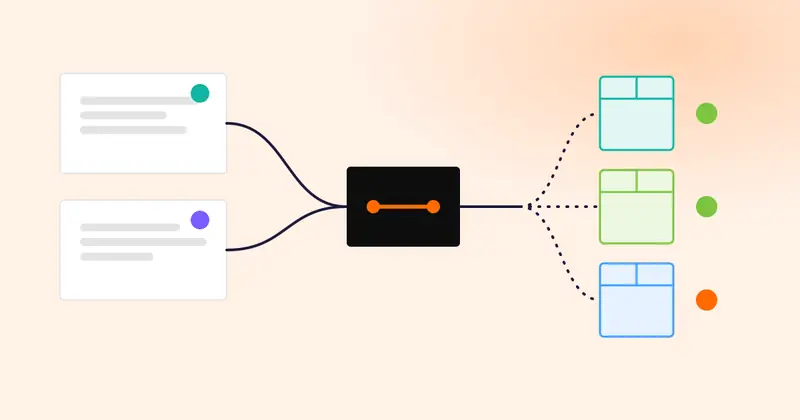
Ecommerce order automation means every online order is checked, routed and confirmed by rules you set once, so nobody retypes it into another system. The order arrives, the rules decide where it goes, the customer hears what happens next, and only the exceptions reach a person.
Why manual order handling stops scaling
Most stores with ten or more staff did not plan their order process. It grew. Orders arrive from the store, from a marketplace and from someone typing a phone order into a spreadsheet. A person copies each one into the shipping tool, emails the warehouse when stock is short, and answers "where is my order" by looking in three places.
That works until volume doubles. Then the same person is doing the copying all day, the error rate climbs, and the team you hired to grow the business is busy keeping orders from falling through the gaps. Online sales are a large and steady channel for US retail: the Census Bureau's latest quarterly estimate puts the share well into double digits.
17.1%
E-commerce share of total US retail sales in the second quarter of 2026, seasonally adjusted. Source: U.S. Census Bureau, Quarterly Retail E-Commerce Sales, released August 18, 2026.
What ecommerce order automation actually does
Think of it as four jobs that run every time an order lands. None of them is new. The change is that a rule does them in seconds, in the same way every time.
- Check: is the address complete, is the item in stock, does the payment match the total?
- Route: which location, carrier or team handles this order, based on the product, the destination and the order value?
- Tell: the customer gets a confirmation, then a shipping notice, by email or text message.
- Escalate: anything that fails a check goes to a named person with the reason attached.
The fourth job matters most. Order automation that silently drops an odd order is worse than none. The aim is to make routine orders invisible and unusual orders impossible to miss.
How to automate ecommerce order routing
Routing is where most stores lose time, so set it up as a short decision table before you build anything. Each row is a condition and the place the order goes.
| Condition | Where the order goes | Who is told |
|---|---|---|
| Destination in the eastern states, item in stock east | East location | Customer and east team |
| Destination in the western states, item in stock west | West location | Customer and west team |
| Item out of stock at the nearest location | The other location | Customer gets a revised date |
| Order value above your review threshold | Held for a person | Operations lead |
| Address fails the check | Held for a person | Customer is asked to confirm it |
Write the table in plain words first. If a row needs a paragraph to explain, it is an exception and belongs with a person. Once the table holds up for a week of real orders, it becomes the set of rules in your workflow builder.
The shipping-notice rule most stores forget
The Federal Trade Commission's Mail, Internet, or Telephone Order Merchandise Rule applies to orders taken online. In short: you need a reasonable basis to expect you can ship in the time you advertise, or within 30 days if you do not state a time. If you cannot, you must tell the customer and offer them the choice to agree to the delay or cancel for a refund.
That is exactly the kind of duty automation is good at. A rule that watches for orders not shipped by the promised date, and sends the notice with a one-tap choice, turns a legal risk into a routine message. This is general information, not legal advice. Read the rule itself, linked in the sources below, and check how it applies to your store.
Where a person still has to decide
Automate the path, not the judgment. Keep these with a named person:
- Refunds above a set amount, and anything that looks like fraud.
- Orders where the customer wrote a note that changes the order.
- Wholesale and repeat buyers with their own terms.
- Any order that failed a check twice.
The store takes 900 online orders a month. Today one coordinator spends about 3 minutes copying each order into the shipping tool, which is 45 hours a month. Valued at €35 an hour, that is €1,575 a month of copying. If rules handle 85 of every 100 orders and the coordinator reviews the other 15 at the same pace, the copying time falls to under 7 hours a month. These are illustrative figures. Put your own order count, minutes per order and hourly cost into the arithmetic.
| Item | hours |
|---|---|
| Before: every order copied by hand | 45 |
| After: only exceptions handled by hand | 7 |
What this means for your team
For a company with 10 to 250 staff, the win is not a smaller team. It is the same team doing work that grows the business: chasing the wholesale account, fixing the product page that loses buyers, calling back the customer whose order went wrong. The person who used to copy orders becomes the person who handles exceptions well.
Start with one location and one channel. Measure the minutes per order and the exceptions per week for a month. Then add the next channel. Our business automation service covers this rollout end to end, including the routing table and the exception rules.
How it fits the rest of the platform
Orders do not live alone. On the levelpartner.ai platform the buyer becomes a contact, the order sits on that contact's record, and the same record drives follow-up, review requests and repeat offers. Checkouts built in AI Studio, the platform's vibe coder, can save the buyer as a contact before payment and show the full order once it is paid, as described in the changelog entry on AI Studio checkout options. Payments, invoices and text-to-pay sit on the payments page.
Everything is on one license, €7,512 a year, with no tiers. Implementation beyond the 30 included onboarding hours is €85 an hour, scoped and approved first.
Sources
- Federal Trade Commission: Mail, Internet, or Telephone Order Merchandise Rule, 16 CFR Part 435 (eCFR)
- U.S. Census Bureau: Quarterly Retail E-Commerce Sales, second quarter 2026, released August 18, 2026
Each source was checked on November 3, 2026.